Monday, November 9, 2015

Where Is Jesus?

Keep on asking, and you will receive what you ask for. Keep on seeking, and you will find. Keep on knocking, and the door will be opened to you. 8For everyone who asks, receives. Everyone who seeks, finds. And to everyone who knocks, the door will be opened. Matthew 7:7-8


I started mentally collecting "quotes of the day" pretty early this morning and it soon became obvious that there were just too many nuggets for a a typical short facebook post. Prepare to have your heart melted!

We started a new Mother Goose Time theme today (On The Go), which also corresponds with our new Bible story, The Little Children Come to Jesus. This is pretty much my favorite story of Jesus! The first activity in the devotional, before actually reading the story, was a little "hide and seek" game, in which I took the story card that showed Jesus with all the children, put it somewhere in the room while everyone had their eyes [mostly] closed, and then said,"OK, open your eyes! Can you find Jesus?" It was comical to watch them looking high and low, in drawers, and under tables, when the picture was actually "hiding" in plain sight. It took some longer than others to find the picture each time, but the ones who "found Jesus" first, helped point their friends in the right direction. And they had so much fun!!

After we returned to the carpet from our adventures of finding Jesus, we read the story. I posed the question,"Where is Jesus?" Here were the responses:

Child 1: "On the mountain!"
Child 2: "In people."
Child 3: "In Jesus' house! Jesus house is big, Big, BIG!"

I asked Child 3 where Jesus' house is, to which he replied,"In the sky."
"In heaven?" I asked. "Yes! Heaven!" We then talked about why Jesus has SUCH a big house, that He has special place prepared for each us. (I see the addition of Audio A's Big House in our song rotation in the near future)

We talked about how sometimes we can see Jesus, but even when we don't see Him, He is always with us. After some further discussion about where we can find Jesus, I asked,"What would you like to talk to Jesus about today?" I mostly ask this to generate thoughts and ideas, so as not to thank Jesus for zebras and "bare necessities" for the 600th time. (although I'm sure Jesus does not object to such grateful sentiments)

Child 4's hand shot up in the air:"YES!"
Me: "What do you want to say to Jesus?"
Child 4: "YES!!"
Me: "What will you say "yes" to Jesus about...that you will listen for His voice and follow Him?" (we talked about the story of the Good Shepherd last month)
Child 4: "Yes! Follow Him!"

Each child then had an opportunity to pray before I said the closing prayer. Most of these conversations with Jesus are unintelligible to me, because they typically choose to kneel and pray face down into the carpet. We just say,"AMEN" in agreement, and assume Jesus got the important details.

Throughout the day, they were singing familiar songs, and making up their own songs to Jesus as they played, all the way up to dismissal time.

So, where is Jesus? Today He was found in preschool in Japan.


Thursday, November 5, 2015

Meaningful Writing in Preschool

“The expert at anything was once a beginner.” ― Helen Hayes

It's hard to believe that we are nearly 2/3 of the way through the school year in Japan! In just the past 2 months since returning from summer break, and beginning our learning adventures with Mother Goose Time curriculum, I have seen so much growth and development in so many areas of my students. One skill that I particularly enjoy teaching, and observing as it develops, is writing. 

Since I had several not-yet-3-year-olds at the beginning of the year, and one child that already turned 5, the range of development was quite broad. But, we have moved from hand-over-hand guidance with some, to everyone learning to making their own meaningful marks on their paper. The MGT little journals offer lots of opportunity to hone writing skills with activities that combine numbers, letters, words, and shapes, with lots of room for individuality. 

They traced 5 square blocks, then turned it into a picture
Same child's journal from September (top) and October (bottom)
Beginning to label his own work


Writing is not limited to paper and pencil, though, and it's not just about "practicing" letters in isolation. The literacy cards and art projects in the MGT curriculum can be used to promote writing in so many different ways that are meaningful, engaging, and fun. 


When it comes to literacy activities, I am never at a loss for ideas, but having an framework and suggested ways to use materials in the MGT teacher planning guide makes it SO much easier to actually implement the things I want to do. 

Rings of a Tree Trunk - Scaffolded Writing Technique (3 yr old)
I also really appreciate the versatility of materials, so I can use them in a way that works for my class, if not exactly as recommended. For instance, we had an "in house" Pumpkin Patch Party, with no outside guests, so I used the provided sign-in sheet in place of our regular sign-in page for students to write their names independently. They usually have a lot more space to work with, so I was impressed by how well the were able to adjust the size of their writing. 


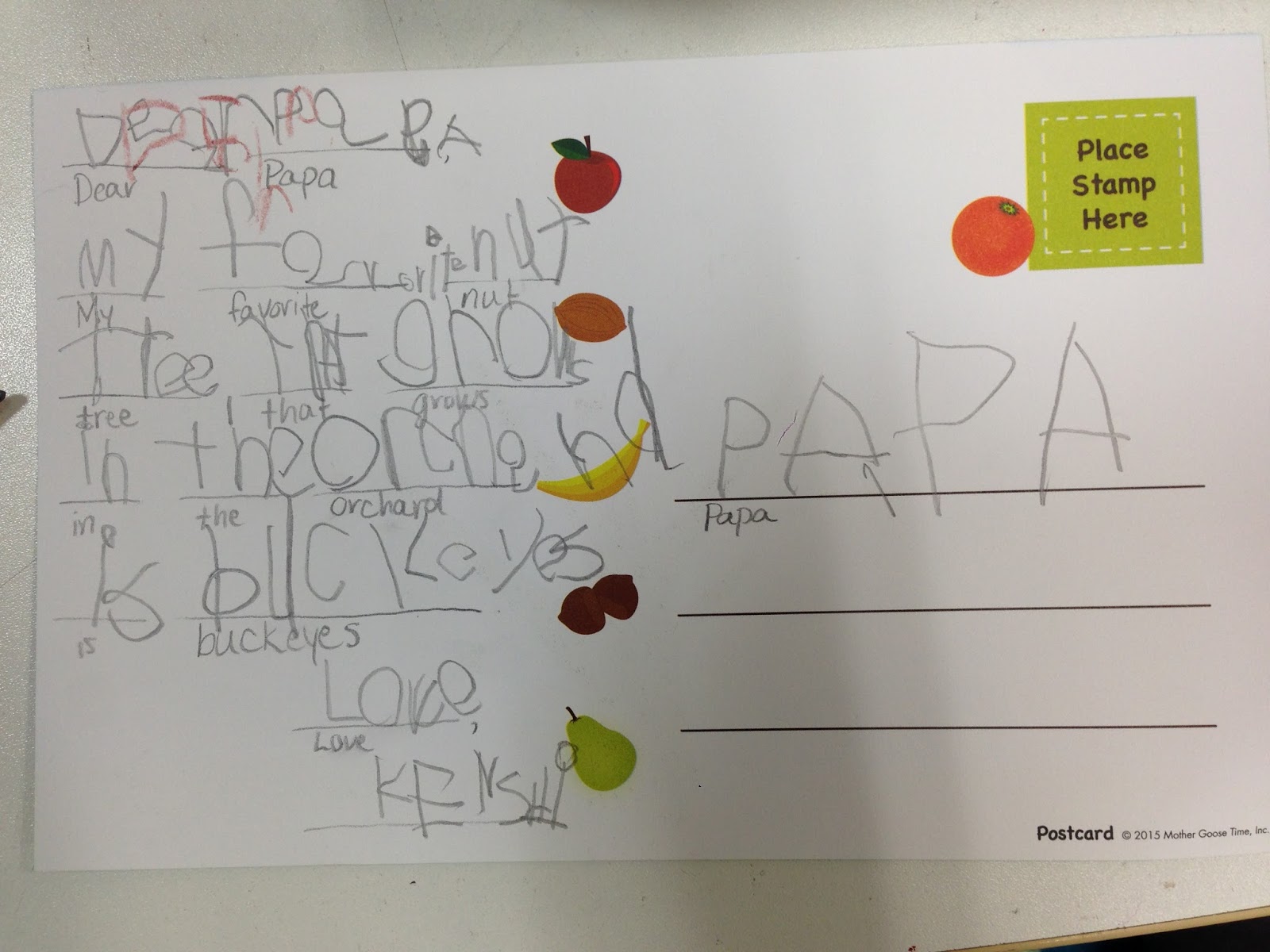
The orchard postcards they wrote yesterday were perfect for showcasing their different stages of writing development. They were so proud of the finished product and couldn't wait to take it home and give it to the person for whom it was written. I almost didn't want to send them home, they were so cute! 


We had "Nut Day" (walnuts & chestnuts) so I couldn't pass up the opportunity
to teach them about buckeyes, too! O-H-I-O!!


These beginner writer's will surely be experts in no time at all!

Tuesday, November 3, 2015

The Art of Process (Art)

2art

noun \ˈärt\
: something that is created with imagination and skill and that is beautiful or that expresses important ideas or feelings
: works created by artists : paintings, sculptures, etc., that are created to be beautiful or to express important ideas or feelings
: the methods and skills used for painting, sculpting, drawing, etc.
1
:  skill acquired by experience, study, or observation 

There are quite a few process art (read:messy) projects in the MGT curriculum, and the past week, or couple weeks, I have tried to both contain the mess & chaos while also observing student response and participation. Therein lies the difference between how adults and children approach multi-step, multi-sensory creative projects. 

But, when we as teachers try to control the process too much, and thus control the "look" of the final product, it's a bit like the scenario of magazines and agencies "over-editing" or photo-shopping models and actresses so much that they publicly start to disassociate with those images that aren't a true representation of their "work". So it is preschool. If a child feels like their creativity or exploration in art is not accepted as valid, then they disassociate themselves from the final product. It might look nice, but they don't view it as their own work, so they don't show pride in it. 

Cherry Trees: 

I particularly enjoyed watching the "evolution" of the cherry blossom tree project. Because we didn't have copious amounts of brown paint to begin with, Instead of painting each child's entire arm, I traced their hand/forearm on the paper and allowed them to finger paint the trunk and leaves. This gave them the freedom to add branches, experiment with color mixing, and get messy without wasting materials. There was so much joy happening at the table! (coincidentally enough, the "joy" fruit of the spirit was represented as cherries in this month's Experience God devotional). Even mishaps like un-popped popcorn kernels were embraced as a natural part of the project when one student decided they should be "cherries" on the tree. Several other students loved this idea, and added cherries to their work as well. 


 Orange Juice, Plumb Pie, and Porcupines

When your only instructions for artistic boundaries are "keep the paint on the paper, not on the table" there is lots of room for creativity! But also giving children choice in what they use to create, or how they use materials (blowing vs. "drawing" with the straw, or paint/crayon/marker) deepens their sense of "self" created art. The fewer parameters and more choice allowed in the process, the greater the joy IN the process and pride in the final product. I typically hand out take-home (3-D) projects when everyone is sitting on the steps for dismissal. This time allows them to "show and tell" with other school staff and administrators while they wait for parents. Flat art is displayed either in the hallway, or in the classroom, often with a description (with ideas taken from group discussion) written on a sentence strip and posted under the art work. 


Art, like life, is messy. It's a learning process, influenced by how we see ourselves and the world around us. Process art helps children not only learn about creative expression, but also life lessons. For instance, mistakes are not the end of the process, and they don't necessarily "ruin" the final product. Rather, they can be seen as "happy little accidents" (thanks, Bob Ross) that provide deeper complexity and can be turned into something beautiful.